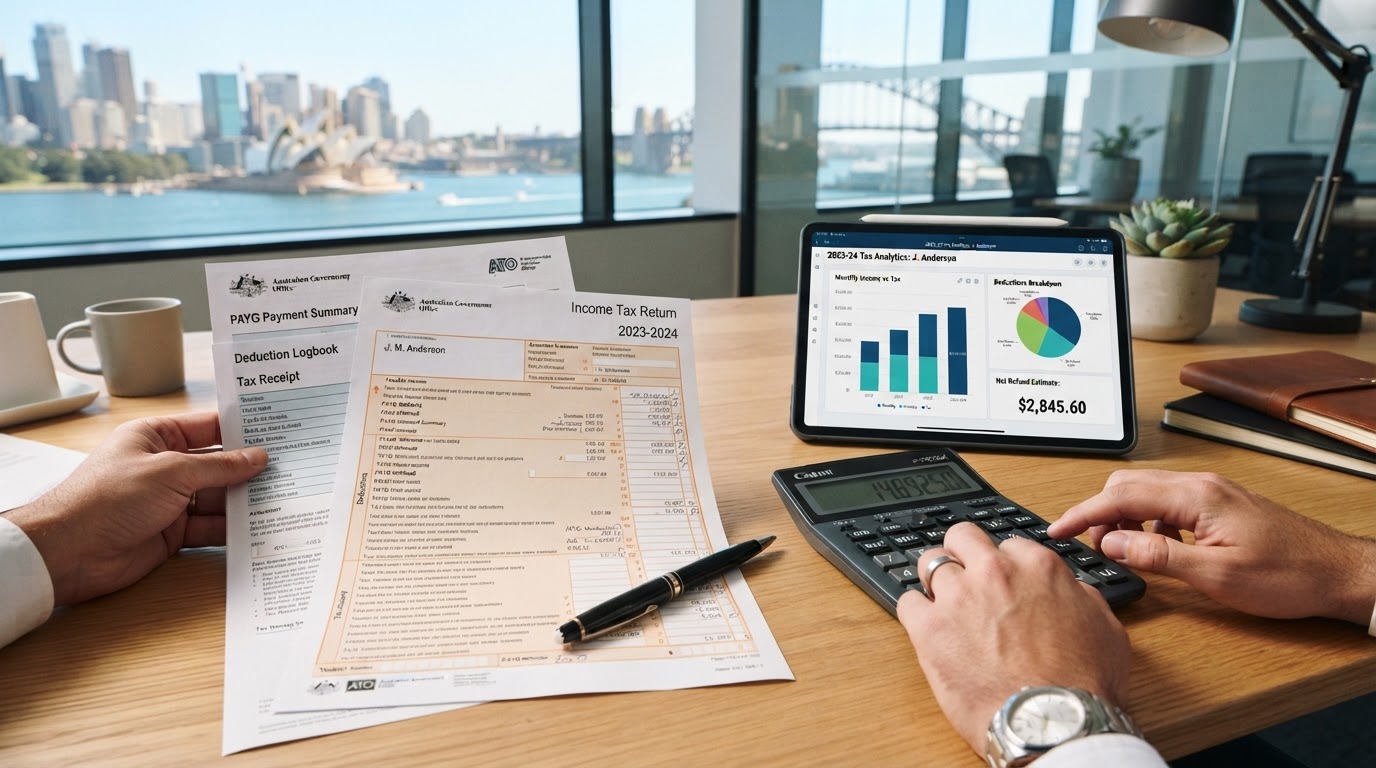
Australian Tax Return Guide: Deductions, Lodgment Dates and ATO Rules
A complete guide to lodging your Australian individual tax return — key ATO deadlines, allowable work deductions, the Medicare levy, and lodgment options through a registered tax agent.
 Freedom Tax12 October 20267 min read
In Australia, the financial year runs from 1 July to 30 June. If you lodge your own individual tax return through the ATO's myTax system, the statutory deadline is 31 October. However, if you are registered with a registered tax agent like Freedom Taxation before 31 October, your lodgment deadline is substantially extended — most clients lodge between January and 15 May of the following year under the tax agent lodgment program. Millions of Australians miss this window each year simply by not engaging an agent early enough.
The three golden rules of ATO deductions
The Australian Taxation Office (ATO) applies three strict criteria before allowing any work-related expense deduction on your individual tax return. Every claimed expense must satisfy all three — failing even one means the deduction is disallowed and may attract penalties and interest.
- You must have spent the money yourself and were not reimbursed by your employer.
- The expense must directly relate to earning your assessable income — personal costs are not deductible.
- You must hold a record to prove it (receipt, tax invoice, logbook, or digital record kept for five years).
The ATO now receives a constant feed of data from banks, employers, share registries, ride-share and sharing-economy platforms, and cryptocurrency exchanges. Data-mmatching means undisclosed income is detected automatically — accuracy and full disclosure have never mattered more.
The 2026-27 individual tax brackets
The revised Stage 3 tax cuts took effect on 1 July 2024. From 1 July 2026, the 16% rate on income between $18,201 and $45,000 was reduced further to 15%. These are the resident marginal rates for the 2026-27 financial year (excluding the 2% Medicare levy):
- $0 – $18,200: Nil (tax-free threshold)
- $18,201 – $45,000: 15c for each $1 over $18,200
- $45,001 – $135,000: $4,020 plus 30c for each $1 over $45,000
- $135,001 – $190,000: $31,020 plus 37c for each $1 over $135,000
- $190,001 and above: $51,370 plus 45c for each $1 over $190,000
Two offsets reduce the tax these brackets produce: the Low Income Tax Offset (LITO), worth up to $700 for incomes up to $37,500 and tapering out by $66,667, and the new Working Australians Tax Offset (WATO), worth up to $250 from 2026-27 for eligible working Australians.
The Medicare levy and the Medicare Levy Surcharge
Most taxpayers pay a 2% Medicare levy on top of their income tax, subject to low-income thresholds. The Medicare Levy Surcharge (MLS) is separate: for 2026-27, singles earning more than $105,000 and families earning more than $210,000 who do not hold an appropriate level of private patient hospital cover pay an additional 1% to 1.5% of their income. For many higher earners, taking out compliant private hospital cover is cheaper than paying the surcharge — and the cover itself is the asset.
Lodging through a registered tax agent
A registered tax agent does more than prepare a return. They assess your full position, identify deductions and offsets you may not know you are entitled to, confirm the accuracy of pre-filled ATO data, and stand behind the lodgment with professional indemnity. Most importantly, registering with an agent before 31 October unlocks the extended lodgment program, giving you additional months to gather records and manage cash flow before any refund or liability is finalised.
Records the ATO expects you to keep
- Income statements finalised via Single Touch Payroll from each employer
- Dividend statements and franking credit details for Australian shares
- Interest received from bank accounts and term deposits
- Rental property schedules, mortgage interest statements, and rates notices
- Vehicle logbooks if using the logbook method for car deductions
- Private health insurance tax statements and spouse income details
Common deductions individuals overlook
- Union and professional association fees directly related to your occupation
- Renewal fees for licences, registrations, and mandatory professional development
- Overtime meal allowances shown on your payment summary, where conditions are met
- Protective equipment, sun protection, and tools required for your role
- Home office running costs using the fixed rate or actual cost method
- Self-education expenses that maintain or improve skills used in current employment
Accurate record-keeping is the single most valuable habit for maximising legal deductions while keeping every return audit-ready.
When the ATO contacts you
If the ATO reviews your return, you will generally be asked to substantiate the deductions you claimed. The burden of proof sits with the taxpayer — a reasonable estimate is not a substitute for a record. Engaging Freedom Taxation means your return is prepared with audit-ready documentation from the outset, and if the ATO does contact you, we manage the response on your behalf. The earlier we are involved, the more options exist to resolve a dispute favourably and avoid penalties.
Related articles
Working From Home Tax Deductions: Fixed Rate vs Actual Cost Method
A complete guide to claiming WFH expenses with the ATO: the 70 cents per hour fixed rate method versus the actual cost method, record-keeping, and equipment claims.
Read article
Understanding Australia's Tax Brackets: Stage 3 Cuts and Take-Home Pay
A complete analysis of Australia's individual income tax brackets, the Stage 3 tax cuts, the 15% rate from 1 July 2026, and how they affect your take-home pay.
Read article
Capital Gains Tax in Australia: The 50% CGT Discount and Property Rules
How Capital Gains Tax works in Australia, qualifying for the 50% CGT discount on assets held over 12 months, main residence exemptions, and the 6-year rule.
Read article